Writer: Juntao Yang
Editor: Jinny Khanduja
This essay was produced in conjunction with the exhibition The Tropics, The Moon, and Mars by Mari Nagem, on view at CUE Art from July 11 – September 26, 2026. The text was commissioned as part of CUE’s Art Critic Mentorship Program, and is included in the free exhibition catalogue available at CUE and online.
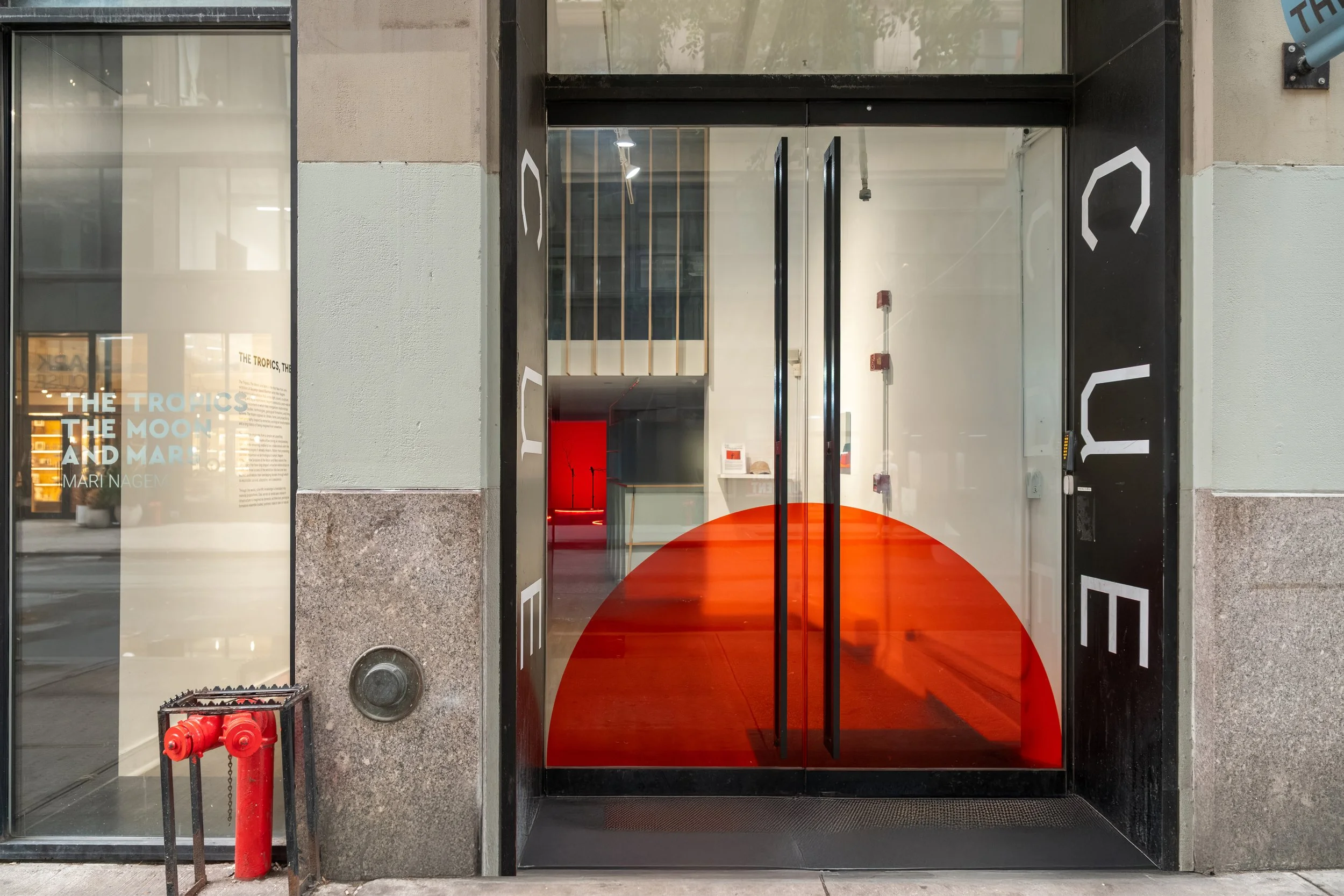
Exterior view of The Tropics, The Moon, and Mars by Mari Nagem, 2026. Photo by Leo Ng.
A semicircle of red is overlaid on a glass door like a rising sun, its shade of red translucent, cool, and futuristic. Through the door is The Tropics, The Moon, and Mars, a solo exhibition at CUE Art by Mari Nagem, a Brazilian artist based in Brooklyn. Within this installation, where a science-fictional atmosphere converges with speculative aesthetics and ecological reflection, Nagem sketches a condition of post-natural survival in which the boundaries separating humans, natural objects, and fabricated items are erased and reimagined, while the material legacies of violence and trauma are remobilized as an expansive dance across bodies and senses. By staging negotiations among artifacts of colonial technics, minerals brought to light by the global extractive enterprise, and plants of uncertain provenance, Nagem seeks to reactivate the undercurrents of ordinary things within geological deep time and (anti-)utopian imagination, articulating a mode of intimacy made inescapable by its historical debts, yet strangely seductive in its orientation toward collective becoming.
Past the narrow vestibule, the depths of CUE’s gallery have been remade. Five rings of red LED tubing, shaped like orbital tracks, immerse the white cube in a heady atmosphere. This conspicuously digital red refuses to enter the genealogy of sunlight or any other natural color; unmistakably artificial in texture, its neon-like saturation wavers between an underground dance floor and the interior of a spacecraft. At an almost preconscious register, the particular shade of red paradoxically offers the composure of cool design while summoning an imagined heat. It provides an apt perceptual context for the exhibition, echoing developmentalist technocracy’s fervent devotion to speed, scale, and frictionless futures. Such technological promises attempt to foreclose reflection and hesitation, claiming that they will lead us to “colonize the Moon” and even “conquer Mars,” although we have yet to reckon with all the damaged relations here on Earth.
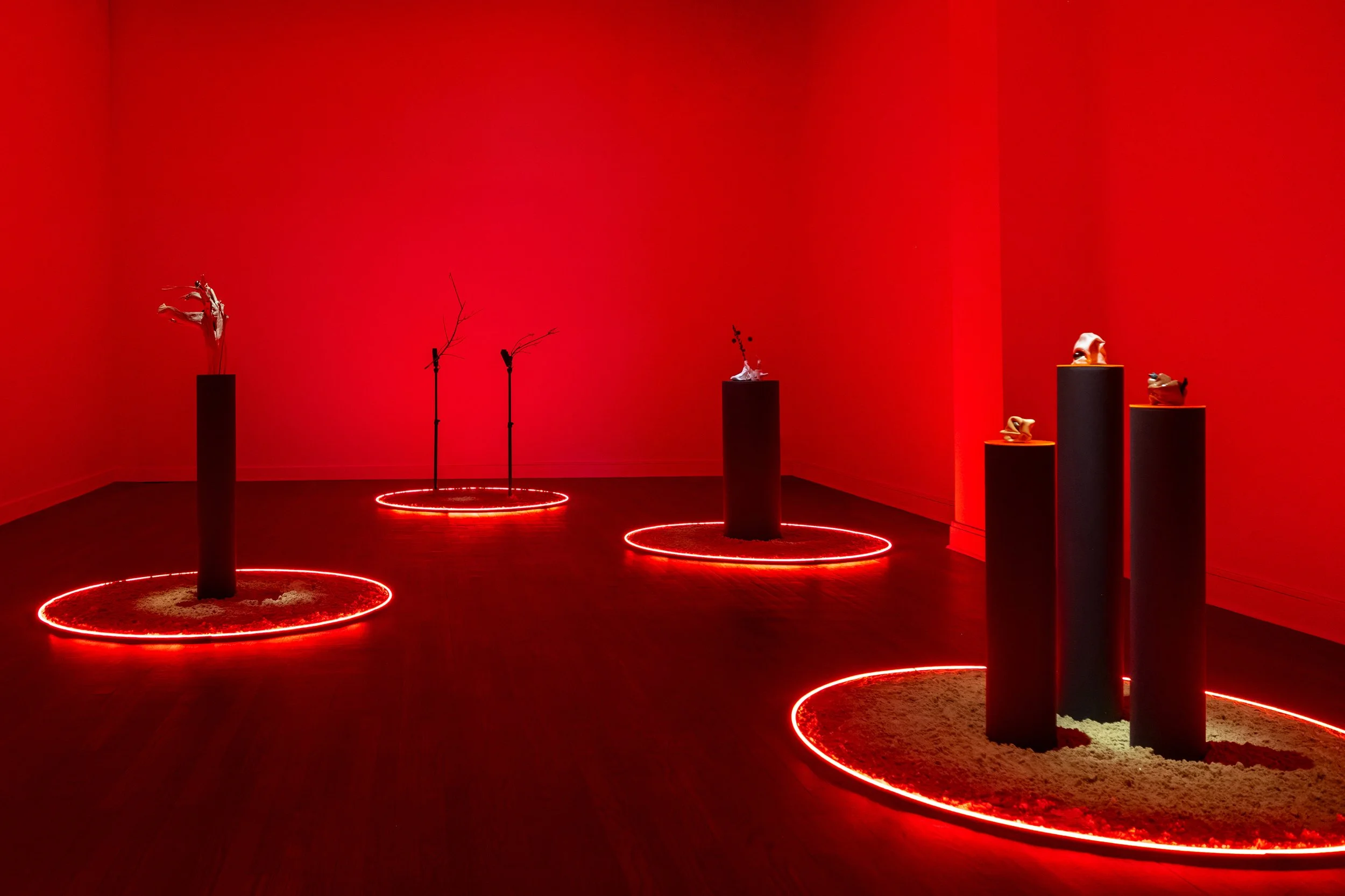
Installation view of The Tropics, The Moon, and Mars by Mari Nagem, 2026. Photo by Leo Ng.
In the gallery, each band of light encloses a circle of sand, within which dark columns of varying heights rise and fall. Inside one of these orbits rests ruínas ninhos, a group of three ceramic objects each roughly six inches to a side. Ivory and ochre toned, they are wrinkled like sheets of paper that have been crumpled and spread open again, each holding a dark mineral deposit and resting on an orange acrylic disc. Against the red light spilling everywhere without restraint, the forms and fabrication of ruínas ninhos demand patience and care, even a ceding of force to geological matter. Nagem treats clay as paper, first spreading it into a two-dimensional surface and then folding until the form closes. The process demands extreme proximity to the clay. The artist must anticipate where a fold will crack, how much water will prevent collapse, and how the material will slump once shaped. After the irreversibility of high-temperature firing, even the artist cannot know its interior structure. Within this almost meditative exercise in material tactility and vulnerability, an intimacy crossing the interface of subjecthood is awakened.
Nagem’s investment in this process of form generation arises partly from the history of mineral extraction in her home country of Brazil and partly from ecological knowledge. Some birds construct basket-shaped nests with circuitous internal passages, placing their eggs in locations so difficult to reach that a predator entering the nest cannot determine where they are hidden. The artist’s negotiation with the material, and her act of burying mineral deposits, can therefore be understood as forms of protection: mountains destroyed by the global extractive industry are compressed into microscopic relics—their formation across geological deep time abruptly severed at the tempo of industry—while minerals once sheltered within the mountain, and now violently seized from it, are returned to an interior refuge.
These forms, retaining the creases of softness while now fired and hardened, might also be ruins left by former mountains. The mountain was once vast; what remains is small, disordered, and residual. Yet protection and vigilance have not disappeared. Through understanding and negotiation, they acquire form once more, turning the ruin into a nest once again preparing itself for what has yet to hatch.
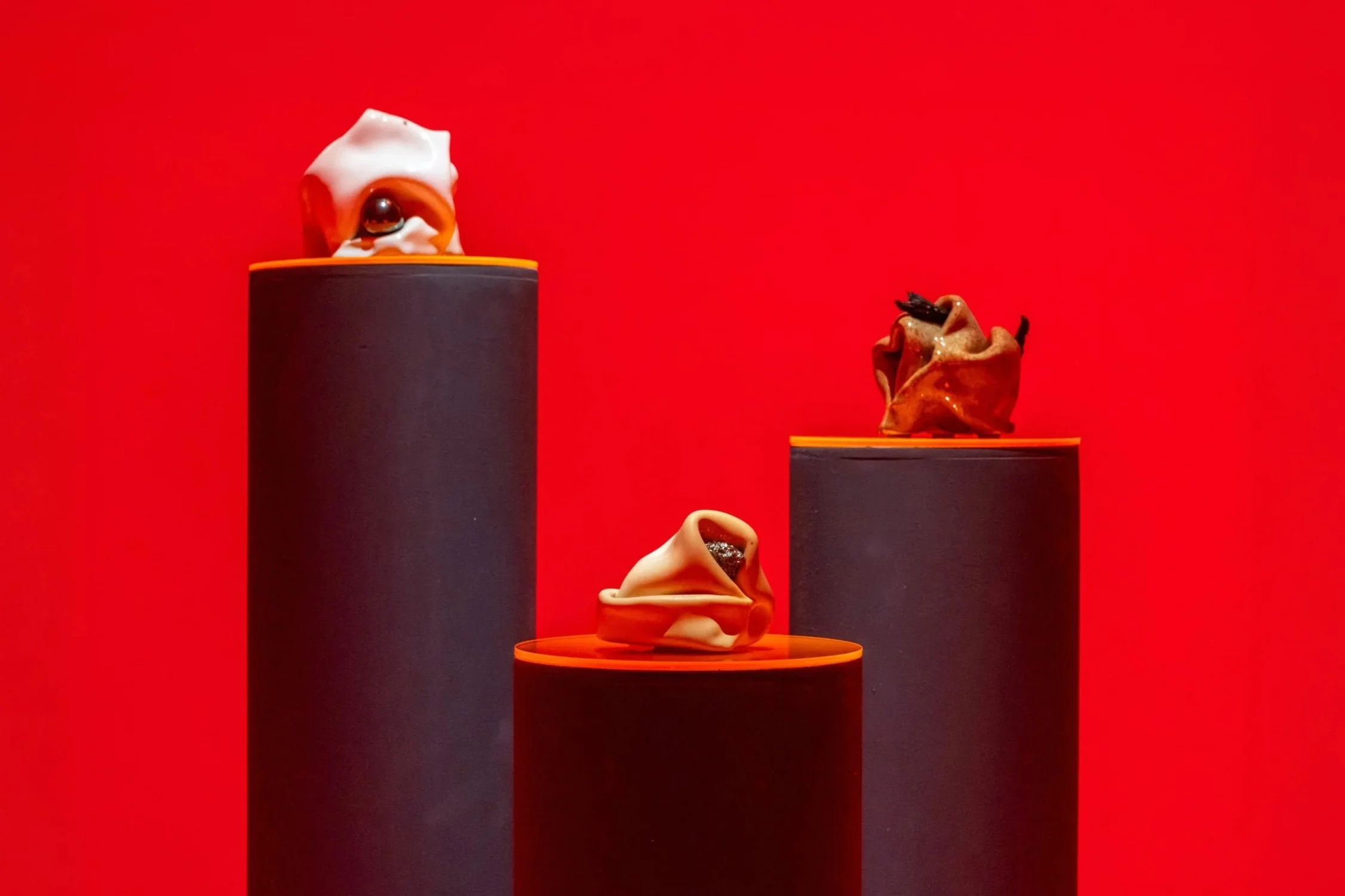
ruínas ninhos, 2026. Ceramic, minerals, acrylic; 4 × 6 × 6 inches each. Photo by Leo Ng.
A recurring concern in Nagem’s practice is the possibility of alternative intervention at catastrophic sites where humans, technological objects, and natural environments meet. From this perspective, heat becomes a subtle medium of relation: the very thing that makes proximity unbearable and yet still possible. In another of the orbits sits à deriva, in which Nagem introduces—or, more precisely, orders online—a dramatically contorted piece of driftwood that has been shaped by water, embedding it with several polished spheres that gleam like eyes, as though inert matter still possessed vigilant nerves. Across from it, bouquet is likewise encircled by red light. At eight inches square, it assumes an almost domestic scale within the gallery. Its ceramic vessel, nearly organic in form, was assembled from remnants of the artist’s previous projects. Everything it contains was gathered rather than cultivated. The acorns come from a sawtooth oak—classified as invasive in the New York region and recovered from the tree nearest Nagem’s Brooklyn home. They are mounted onto brightly colored acrylic tubes that resemble fiber optics but have been bent into vegetal stems and roots. Beside them are a dried cutting of eucalyptus; a finger-shaped piece of driftwood gathered by the artist from Marajó Bay at the mouth of the Amazon, one of its smaller branches painted bright orange; and a small piece of chalcopyrite. These seemingly unrelated elements are assembled according to neither taxonomy nor shared habitat. What provisionally draws them together is a faint formal kinship among color, curvature, scale, and texture.
Flower arrangement can itself be understood as a miniature curatorial act. Through it, Nagem constructs the hybrid scene we already inhabit: invasive, fallen, and untraceable things, things forcibly severed from their original contexts and relations, are reordered according to a logic of attentive care, producing an aesthetics of juxtaposition unabashed about its own heterogeneity. Traced back to the Greek aisthēsis, the etymological root of aesthetics points toward sensation and sensory perception. A hybrid aesthetics thus becomes an education of perception, requiring us to recognize and see those abjected things that have been fragmented and forcibly displaced, and to imagine a solidarity, or a reconstruction after the storm.
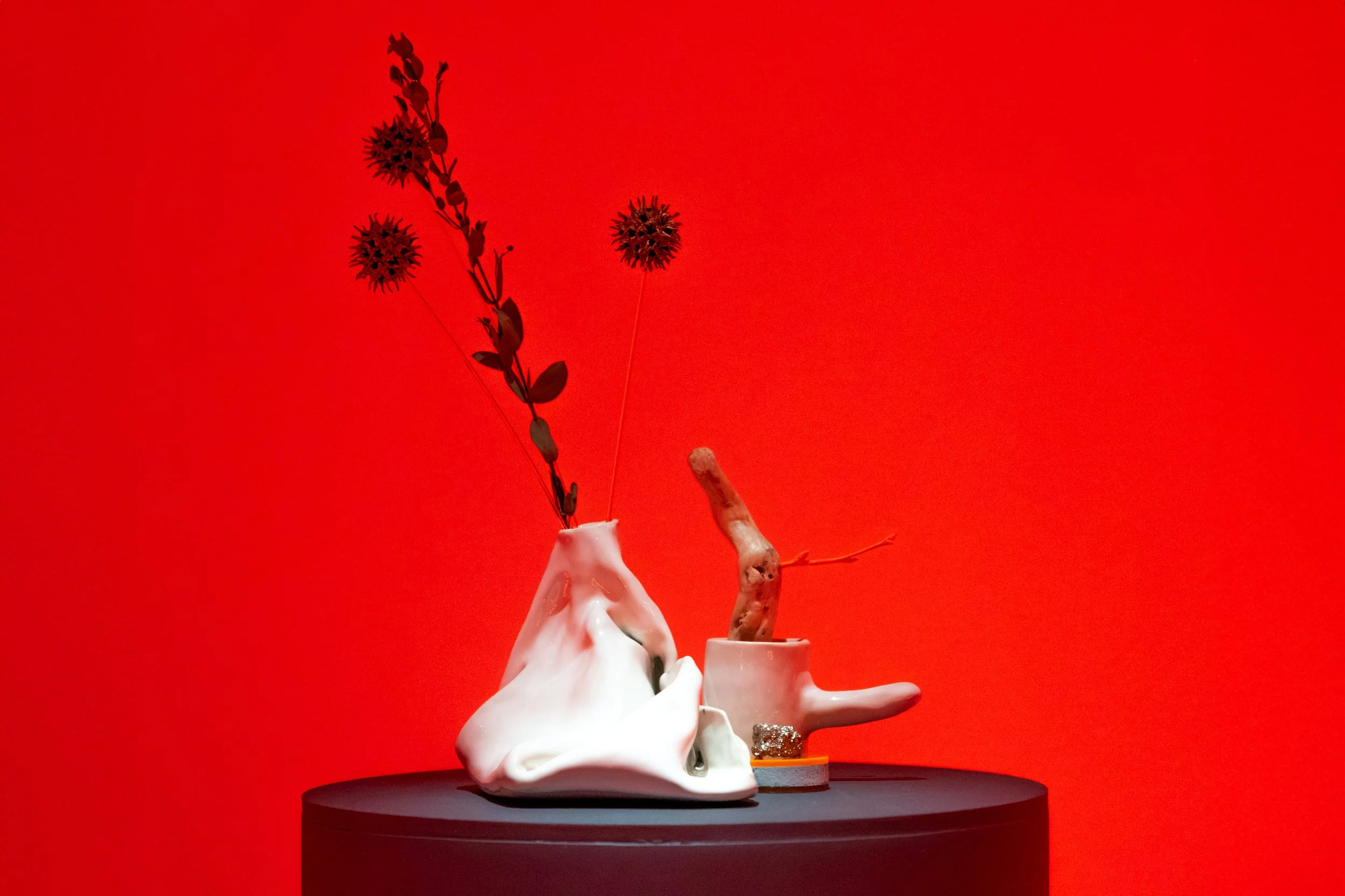
bouquet, 2026. Ceramic, acrylic, plastic, mineral, driftwood from Marajó Bay, found sawtooth oak acorns, eucalyptus; 12 × 8 × 8 inches. Photo by Leo Ng.
Can the invasive be intimate? Are we permitted to enter into intimacy with things that are anything but authentic, whose origins are uncertain, and which may bear the unmistakable traces of violence? If such an effort, practice, and act of imagination are indeed viable, can we, within this critical intimacy, rebuild and reorganize our relations with the things around us, opening a passage toward an alternative future? The answers are perhaps more complex than any exhibition could provide. Yet Nagem has found a formal language through which such intimacy can be felt and described. It lies dormant in her investment in hybrid bodies and fragile things, generated by the stratified pressures of complex causalities and embedded deep within the legacies of geological time and political violence. It acknowledges the violence of what has been, while awakening an impulse to repair that persists in full knowledge that redemption can never be complete.
The orbit containing flora futura (or the survival dance) may best clarify this. Several bare branches are held in place by supports and set into slow motion by custom motors. The supports are microphone stands, fitted at their tops with 3D-printed components designed to grip the branches. What would have otherwise projected the sound of humans has instead become an invitation addressed to a leafless branch to speak. And sound is indeed present in the room. A sound work by Mapuche-Brazilian musician Brisa Flow, commissioned by CUE at Nagem’s invitation, encircles the space, flowing like a river and winding around the rings of light.
The branches of flora futura point toward a long-term experiment conducted by the Museu Paraense Emílio Goeldi and the Federal University of Pará in Brazil’s Caxiuanã National Forest. In the study, panels installed beneath the forest canopy diverted a portion of the throughfall, making the rainforest perform a drought in real time so that scientists could observe how it responded to a sustained reduction in rainfall. Here, scientists were already speculating on the ecological future, and so the artist chose to speculate in turn. The movement of the branches and mechanisms resembles a dance, a clock, even a sundial. Nagem directs my attention to the shadows on the floor: you cannot tell whether they are dying or growing. Survival hangs suspended between withering and growth.
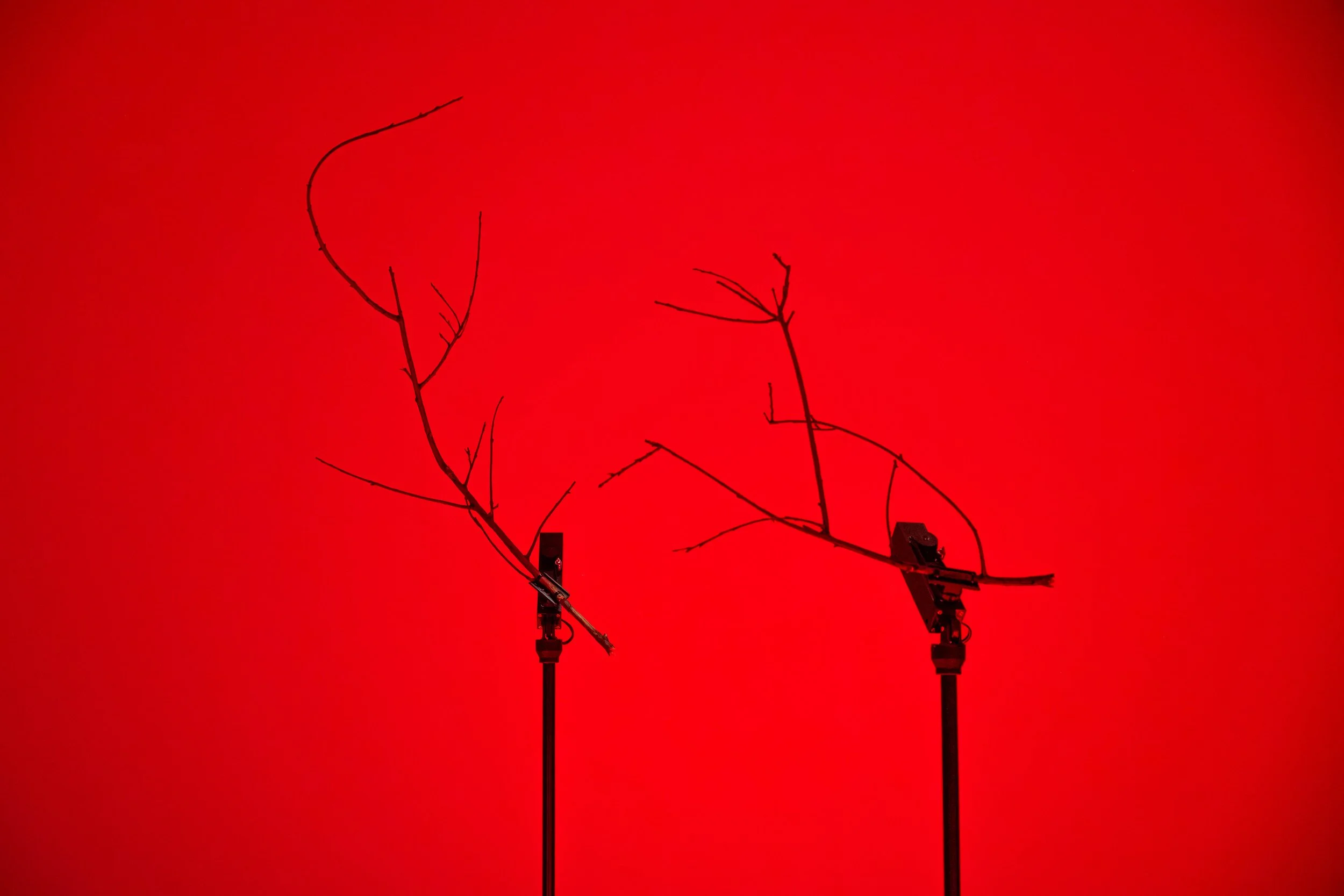
flora futura (or the survival dance), 2026. Found branches, wood sealant, motors, custom hardware; dimensions vary with installation. Photo by Leo Ng.
pássaros rodantes (whirlybirds), installed inside another orbit, tightens this indeterminate dance step into a circular movement that repeats itself. A cluster of wooden birds turns slowly atop a column, its surface coated in enamel and its eyes covered with white vinyl film. Its jarring synthetic sheen keeps the birds alert while dislodging the wood carving from its secure position as an innocent representation of nature. The object remained in Nagem’s family home for more than forty years. It was originally given to her mother by a relative who has since died. The child of two biologists, Nagem grew up among carved animals, charts of flora and fauna, and diagrams of human reproduction, and yet for years she overlooked this cluster of birds, regarding it as a slightly gaudy piece of domestic handicraft that required no closer attention.
Only when her young niece casually called them “the rounding birds” did a name unconstrained by taxonomy compel Nagem to look again. Every bird had been carved from the same continuous section of tree trunk, without joints or later assembly, as though they had always lain together within the wood, differentiating themselves from a single material body. Now a custom motor turns this family heirloom in reverse. Birds ordinarily orient their migratory routes through changes in climate and season; here, the flock remains in constant motion but is no longer capable of arriving anywhere. More subtly, “reverse” does not exist within the circle itself. Only the direction of the birds’ beaks instructs the viewer as to what counts as forward and what is otherwise. The body provides time with its coordinates; when the body loses its orientation, time loses its direction as well.
Rotation thus becomes orbit, clock, and a dance step from which there is no exit. It retains the form of the cycle while withdrawing the return and renewal that cyclicality promises. The intimacy encountered here offers no consolation of resynchronization with “natural rhythms.” The viewer is compelled to acknowledge that humans and birds, family heirlooms, synthetic materials, and planetary climate have long been locked inside the same temporal apparatus, disoriented yet still turning. The exhibition compresses light, bodies, experiments, and planetary warming into an environment of dysregulated heat. The living beings, minerals, and technologies within it carry mutually incompatible histories, yet must still rehearse how to occupy space and time together.
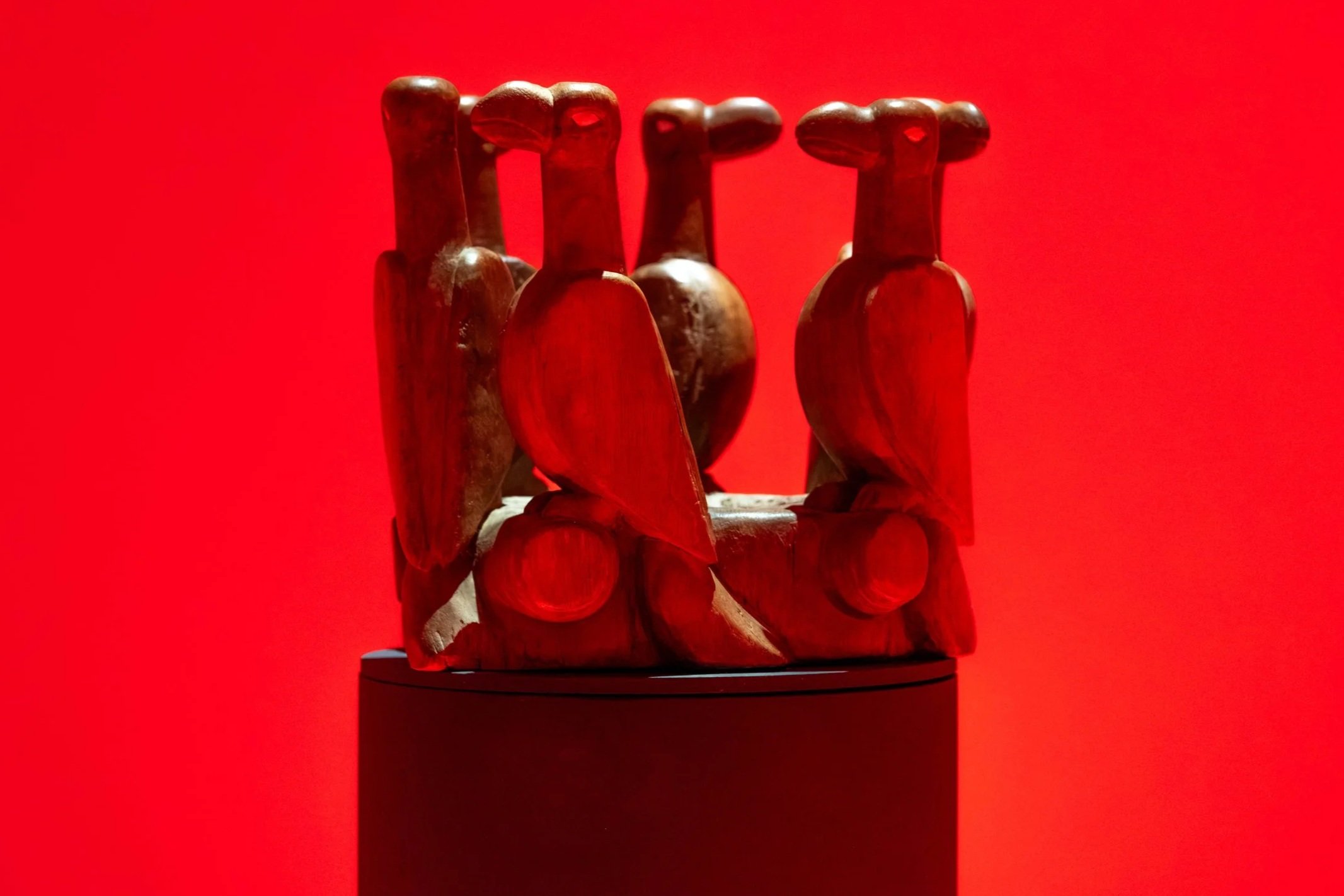
pássaros rodantes (whirlybirds), 2026. Family heirloom wooden sculpture, enamel, vinyl, custom motor; 12 × 12 × 12 inches. Photo by Leo Ng.
Returning to the front of the gallery, a painting titled tropics | moon | mars | ES converts Google Ngram data—the changing frequency of the terms naming the exhibition’s three locales, in this case, within a Spanish-language corpus—into a painted topography. Linguistic recurrence takes on geological relief, allowing tropical geography and interplanetary fantasy to rise and fall across the same terrain.
A few steps away, in an inconspicuous corner parallel to the reception desk, space analog sits silently, although its uses remain in constant flux. This stainless-steel table, with its distinctly laboratory-like aesthetic, bears dotted lines in white vinyl marking the latitudes of the Tropics of Cancer and Capricorn—or, more precisely, one moment in the Earth’s slowly shifting obliquity—alongside figures of temperature and scale. At its far end lies a less than inviting gray pillow, although viewers have begun asking whether they are permitted to lie down. Several faint scratches across the metal suggest that the object has performed a wider range of work. Its utility remains deliberately ambiguous, shifting at different moments among bed, table, workstation, and platform.
Within the exhibition, this product of heavily encoded colonial engineering—its functional economy modeled on that of the space-habitat simulator at Biosphere 2—paradoxically reveals another ambition. At the opening reception, cratered rounds of pão de queijo were placed across its surface. People packed shoulder to shoulder maneuvered through the space as though performing a dance, enveloped by Brisa Flow’s composition of chants, bird and insect calls, electronic hums, drumbeats, and breathing.
Is this a suggestion, or a synecdoche? We bake, eat, celebrate, and converse, and the cold metallic construction is repurposed as a platter for a shared moment. Within an ongoing mourning and blessing that acknowledges our own fragility, people attempt to bear and digest together the consequences left by extractivism. An opening reception cannot, of course, repay all these material debts. Alternative intimacy is not proclaimed as the future, but here, in this space, it can be rehearsed for one evening.
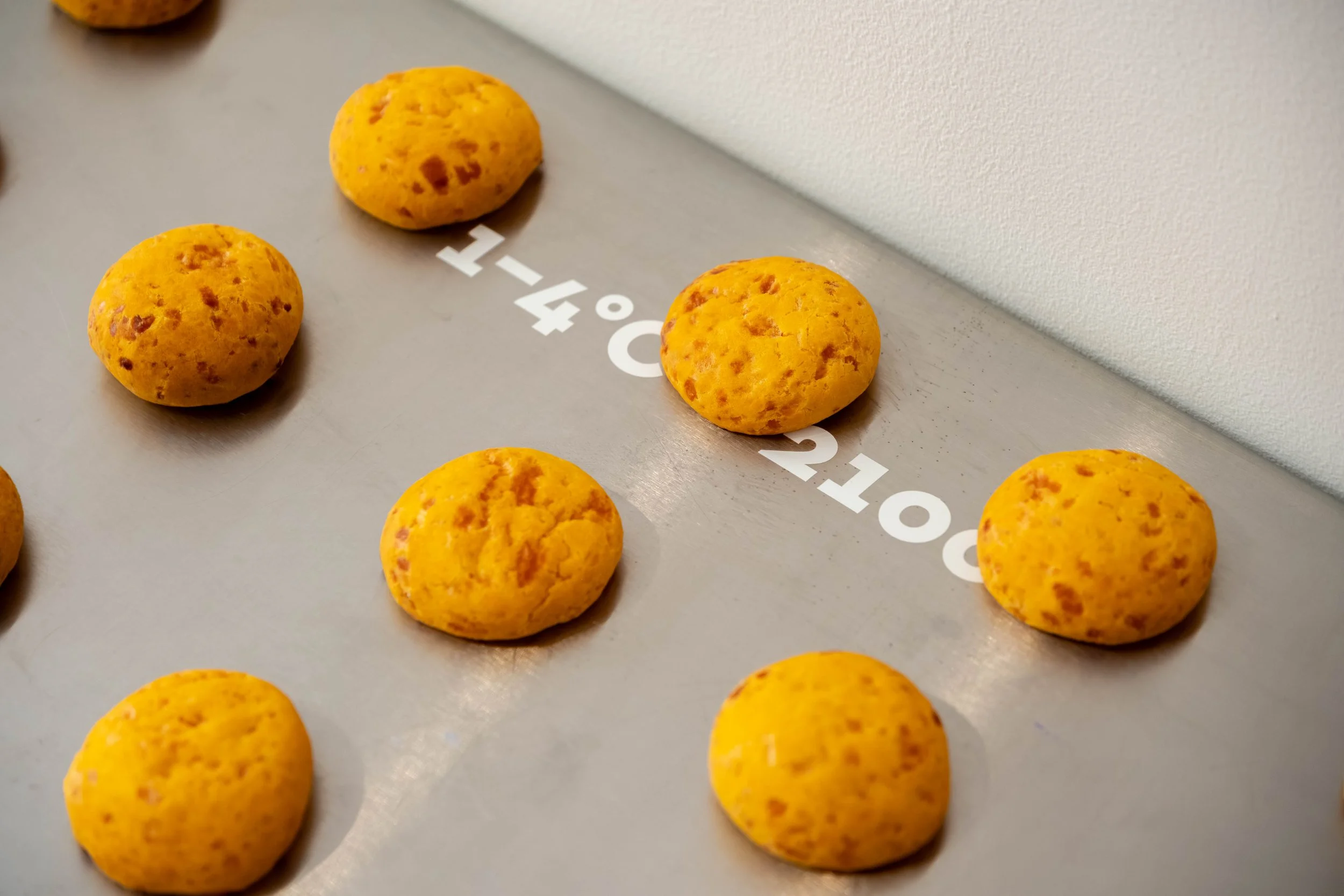
Opening reception of The Tropics, The Moon, and Mars by Mari Nagem, 2026. Photo by Leo Ng.
About the Writer
Juntao Yang is a scholar, critic, and artist working across media theory, environmental humanities, and queer theory, with contemporary cinema, visual art, and popular culture as primary objects. Yang is concerned with how power operates through material and mediatic processes—often invisibly, at the micro-level. Yang is a PhD student in Film & Media at the University of California, Berkeley, and holds an MA in Film and Media Studies from Columbia University. Yang is a member of the International Association of Art Critics (AICA), and is based in Berkeley and Nanjing.
About the Editos
Jinny Khanduja is a cultural facilitator whose work spans writing, editing, design, administration, and curatorial care of artists’ work and ideas. She has worked in nonprofit arts organizations for more than 15 years, holding a wide range of roles that bridge programs, communications, development, strategy, and leadership. Her practice is grounded in a commitment to new forms of organizational stewardship that challenge conventional models and bring programmatic and operational work into closer alignment. As Executive Director of CUE, she leads the organization’s strategic vision and artist-centered programs. She is invested in building responsive structures that make this work possible, and in creating space for artists’ practices to remain fluid, ambitious, relational, and deeply engaged.
About the Art Critic Mentorship Program
This text was written as part of the Art Critic Mentorship Program, a partnership between CUE and the AICA-USA (the US section of International Association of Art Critics). The program pairs emerging writers with art critic mentors and editors to produce original essays about the work of artists exhibiting at CUE. Learn more about the program here. No part of this essay may be reproduced without prior written consent from the author.