
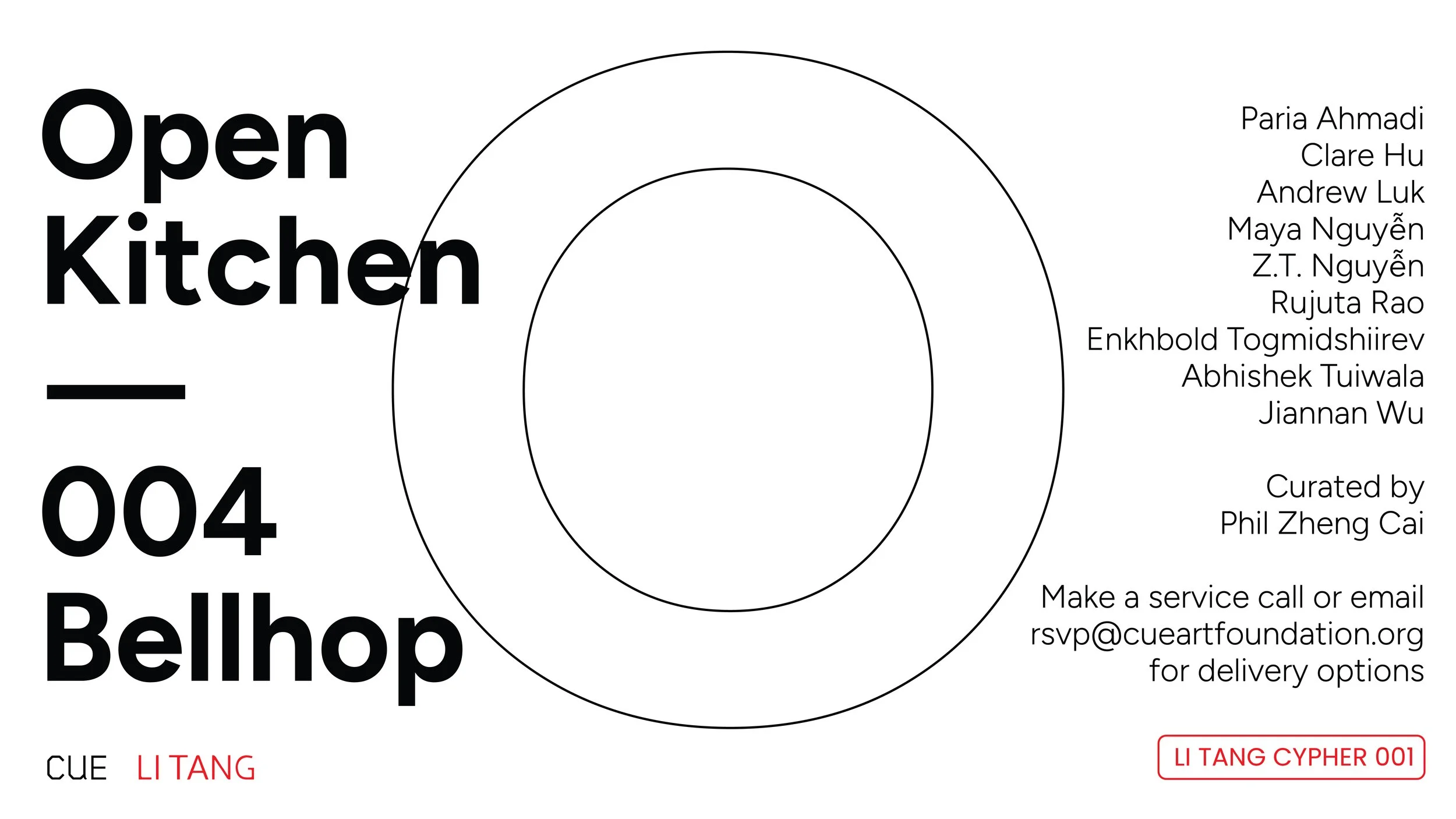
Open Kitchen 004: Bellhop
Organized by Li Tang Community
Curated by Phil Zheng Cai
Presented at CUE Art
November 19 – December 12, 2026
Opening Reception: Thursday, November 19th, 6–8pm
“It is necessary to forget entirely one's intellectual culture, not in order to assimilate the work of art, but to deliver one's self up to it, heart and soul.” — Italian Futurist Painters' Manifesto, 1912
More than a century after the Italian Futurists called for the complete surrender of oneself to art, the language of delivery has acquired another decidedly less transcendent meaning. We deliver meals, groceries, packages, and increasingly, almost anything we desire, with the expectation that the distance between wanting something and receiving it should be as short as possible. Behind each seemingly effortless transaction is an elaborate choreography of bodies, infrastructures, and obligations. Someone must answer the calls.
Open Kitchen 004: Bellhop, curated by Phil Cai and organized in collaboration with Li Tang Community and CUE Art, takes this logic to its absurd, and perhaps inevitable, conclusion: an exhibition that can be summoned to your doorstep upon request.
Bringing together works by nine artists from the Asian diaspora, Bellhop operates simultaneously as an exhibition and an on-demand delivery service. Visitors may encounter the works at CUE or request that a portion of the exhibition be brought to them by making a service call. A bellhop cart stationed in the gallery serves as its mobile infrastructure. When a request arrives, the curator, artists, staff, interns, or volunteers pack selected works onto the cart and transport them to their destination. In their absence, the exhibition at CUE remains incomplete.
This simple arrangement unsettles several assumptions about the format of an exhibition and who it serves. The visitor who travels to the gallery may find that the work they came to see has been dispatched elsewhere, while the caller, who stays home, commands its movement. The collective experience of an exhibition becomes contingent upon individual requests. Availability for some produces absence for others; convenience is purchased through the time, movement, and attention of other people.
The humor of this proposition depends on a familiarity that is difficult to escape. We have grown accustomed to a world organized around the promise of immediate gratification, in which the friction of everyday life is increasingly transferred onto others. The distance between desire and fulfillment appears to collapse, while the distance between those who request and those who serve is easier to overlook. Even our understanding of access is shaped by this arrangement: to make something accessible is increasingly understood as making it available to us, on our terms.
Yet we are neither simply consumers of these systems nor innocent observers of their consequences. We inhabit them in contradictory ways, moving between positions of dependence, authority, accommodation, and demand. We may recognize the exploitation embedded in technological services while continuing to use them; insist on fair labor conditions while expecting immediate responsiveness; advocate for broader cultural access or support without fully accounting for the people and resources required to sustain it. Our participation is seldom reducible to a single position, and awareness offers no automatic exemption from complicity.
For Asian diasporic artists and cultural workers, the figure of the bellhop carries particular historical and social weight. The racialization of Asian labor in the United States has long relied on contradictory expectations: industriousness and invisibility, technical competence and political deference, exceptional productivity and unquestioning service. These associations flatten profoundly heterogeneous communities into an imagined disposition toward work, assigning value to what they produce while limiting recognition of their agency in determining the conditions of that production.
Bellhop inhabits this contradiction with deliberate discomfort. The artists are both the producers of the work and, potentially, the people tasked with delivering it. The curator and the gallery staff become dispatchers; the exhibition becomes an inventory of objects available for temporary circulation; the organization becomes a service point. The project invites its participants to perform the very hierarchies it seeks to expose. It cannot stand outside those hierarchies simply by making them visible. Indeed, the possibility that its critique may reproduce the conditions it questions is central to the work.
Nor is the audience exempt. To request a delivery is to activate the exhibition, but also to make a claim on someone else's labor. To visit the gallery is to participate in a different expectation: that art should be waiting, available, and ready for our encounter. Both positions presume an infrastructure of care and work whose presence is often acknowledged only when something fails. The empty space left by dispatched artworks becomes a record of these competing claims, a small interruption in the assumption that cultural resources can be endlessly available to everyone at once.
For CUE, the project also raises questions about the responsibilities and limits of a cultural organization. The aspiration to make art more accessible is inseparable from decisions about whose access is prioritized, who determines the terms of participation, and who bears the labor of extending the gallery beyond its walls. An exhibition cannot be everywhere. The people who work at a small cultural organization cannot answer every call. Yet the expectation that it should try is deeply embedded in contemporary cultural life, often celebrated as generosity, innovation, or public service.
The exhibition offers no comfortable division between those who perpetuate these conditions and those who resist them. Its participants are implicated in the systems they examine, just as its visitors are implicated in the demands they make. There is no pure position from which to observe the transaction, and the act of making these relationships visible does not, in itself, transform them. Even critique becomes another form of work, another service offered, another experience made available for consumption.
The Futurists imagined delivering oneself to art as an act of ecstatic surrender, a devotion that might dissolve the distance between life and artistic experience. More than a century later, Bellhop returns that ambition to the material world, where surrender is rarely innocent. Bodies are tired, objects are carried, distances are traversed, requests are answered, and the freedom to give oneself over to something is not equally afforded to everyone. Between the person who rings the bell and the person who arrives at the door lies a set of relationships that no amount of convenience can make disappear. To deliver oneself, to deliver art, to be at another's service: these gestures share a vocabulary but inhabit vastly different relations of power.
How can we sustain a shared cultural life without taking for granted the availability of other people's labor? How can our commitments to art, to access, and to one another can extend beyond the moment of our own satisfaction? Bellhop holds these ideas together, with all their contradictions, asking how much of ourselves we are willing to give, how much we expect from others, and whose devotion we have mistaken for an obligation.
About Li Tang Community
Li Tang Community is a New York–based, artist-run nonprofit organization dedicated to supporting creative practices across the global Asian diaspora. Founded in 2020, the organization works with artists, designers, and cultural practitioners across disciplines to develop opportunities for presentation, exchange, and collaboration.
About Open Kitchen
Open Kitchen is a curatorial initiative founded by Phil Zheng Cai that examines the social, institutional, and economic systems shaping contemporary life. Building on traditions of institutional critique, the initiative extends its inquiry beyond art institutions to consider the structures and conventions through which culture is produced, circulated, and experienced.
Press Inquiries
Click here to download a PDF version of the exhibition press release. For more info or press materials, email press@cueartfoundation.org
Artwork Preview Photos
Exhibition Credits
Open Kitchen 004: Bellhop. Curated by Phil Zheng Cai. Presented by CUE Art, 2026.
Bellhop Cart & Station Production: Andrew Luk
Art Handling: Paria Ahmadi, Phil Zheng Cai, Clare Hu, Andrew Luk, Maya Nguyễn, Vu Thien An (Thea) Nguyen, Z.T. Nguyễn, Rujuta Rao, Abhishek Tuiwala, Jiannan Wu, Zoe Zheng
Poster Design: Mengyao Zhang
Curatorial Assistants: Vu Thien An (Thea) Nguyen, Zoe Zheng
Program Assistant: Jianing Lu, Xiaojing Zhu
Program Manager: Iris Zhang, Abhishek Tuiwala
Program Producer: Webson Ji
Support
Programmatic support for CUE Art is provided by the Arison Arts Foundation; The Andy Warhol Foundation; Evercore, Inc; and members of CUE. Programs are also supported, in part, by public funds from the New York City Department of Cultural Affairs, in partnership with the City Council; and the New York State Council on the Arts with the support of Governor Kathy Hochul and the New York State Legislature.